Did Bengio and Tegmark lose a debate about AI x-risk against LeCun and Mitchell?
webAuthor
Credibility Rating
Good quality. Reputable source with community review or editorial standards, but less rigorous than peer-reviewed venues.
Rating inherited from publication venue: EA Forum
A commentary post analyzing a notable public debate between AI safety advocates (Bengio, Tegmark) and skeptics (LeCun, Mitchell), useful for tracking expert discourse and public argumentation around AI x-risk.
Forum Post Details
Metadata
Summary
This EA Forum post analyzes a public debate between AI safety proponents Yoshua Bengio and Max Tegmark versus skeptics Yann LeCun and Melanie Mitchell on the question of AI existential risk. The post examines the arguments made by each side and assesses who presented more compelling reasoning, offering a perspective on the rhetorical and substantive merits of the exchange.
Key Points
- •Features a high-profile debate between prominent AI researchers on opposing sides of the AI x-risk question
- •Bengio and Tegmark argued for taking AI existential risk seriously; LeCun and Mitchell argued against current AI posing such risks
- •The post evaluates debate performance and argument quality rather than simply restating positions
- •Highlights deep disagreements among expert AI researchers about the nature and likelihood of catastrophic AI outcomes
- •Relevant for understanding the public discourse and expert opinion landscape on AI safety concerns
Cached Content Preview
# Did Bengio and Tegmark lose a debate about AI x-risk against LeCun and Mitchell?
By Karl von Wendt
Published: 2023-06-25
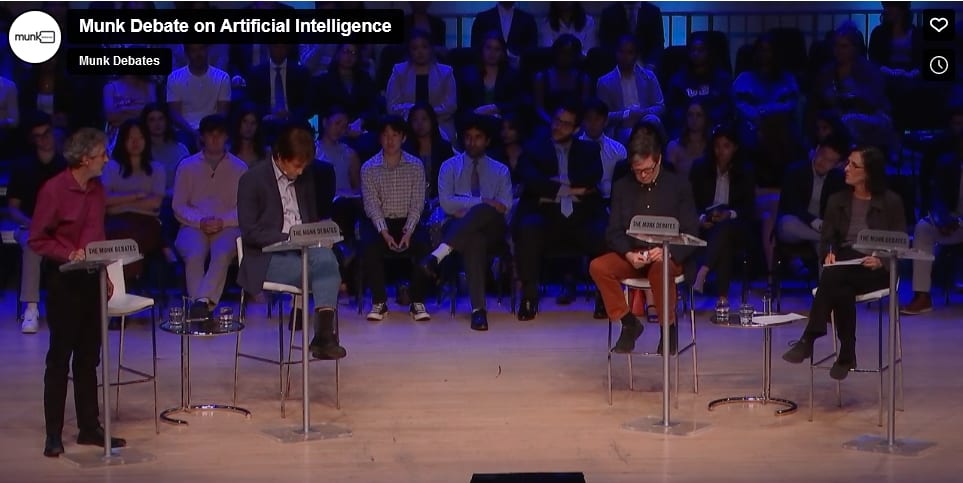
On June 22nd, there was a “Munk Debate”, facilitated by the Canadian Aurea Foundation, on the question whether “AI research and development poses an existential threat” [(you can watch it here](https://munkdebates.com/livestreamai), which I highly recommend). On stage were Yoshua Bengio and Max Tegmark as proponents and Yann LeCun and Melanie Mitchell as opponents of the central thesis. This seems like an excellent opportunity to compare their arguments and the effects they had on the audience, in particular because in the Munk Debate format, the audience gets to vote on the issue before and after the debate.
The vote at the beginning revealed 67% of the audience being pro the existential threat hypothesis and 33% against it. Interestingly, it was also asked if the listeners were prepared to change their minds depending on how the debate went, which 92% answered with “yes”. The moderator later called this extraordinary and a possible record for the format. While this is of course not representative for the general public, it mirrors the high uncertainty that most ordinary people feel about AI and its impacts on our future.
I am of course heavily biased. I would have counted myself among the 8% of people who were unwilling to change their minds, and indeed I’m still convinced that we need to take existential risks from AI very seriously. While Bengio and Tegmark have strong arguments from years of alignment research on their side, LeCun and Mitchell have often made weak claims in public. So I was convinced that Bengio and Tegmark would easily win the debate.
However, when I skipped to the end of the video before watching it, there was an unpleasant surprise waiting for me: at the end of the debate, the audience had seemingly switched to a more skeptical view, with now only 61% accepting an existential threat from AI and 39% dismissing it.
What went wrong? Had Max Tegmark and Yoshua Bengio really lost a debate against two people I hadn’t taken very seriously before? Had the whole debate somehow been biased against them?
As it turned out, things were not so clear. At the end, the voting system apparently broke down, so the audience wasn’t able to vote on the spot. Instead, they were later asked for their vote by email. It is unknown how many people responded, so the difference can well be a random error. However, it does seem to me that LeCun and Mitchell, although clearly having far weaker arguments, came across quite convincing. A simple count of the hands of the people behind the stage, who can be seen in the video, during a hand vote results almost in a tie. The words of the moderator also seem to indicate that he couldn’t see a clear majority for one side in the audience, so the actual shi
... (truncated, 17 KB total)346c72565d80a8f4 | Stable ID: sid_Il0oiG114J