AI Safety Field Growth Analysis 2025
webAuthor
Credibility Rating
Good quality. Reputable source with community review or editorial standards, but less rigorous than peer-reviewed venues.
Rating inherited from publication venue: EA Forum
A useful reference for researchers and funders assessing the scale and growth rate of the AI safety field; numbers should be cross-checked against other workforce surveys as FTE estimates in this field vary significantly by methodology.
Forum Post Details
Metadata
Summary
A longitudinal study tracking the growth of the AI safety field from 2010 to 2025, documenting expansion from approximately 400 to 1,100 full-time equivalent researchers across both technical and non-technical domains. The analysis provides quantitative benchmarks for understanding the field's scaling trajectory and workforce development over 15 years.
Key Points
- •Field grew from ~400 to ~1,100 full-time equivalent researchers between 2010 and 2025, representing roughly a 2.75x increase.
- •Tracks both technical AI safety (alignment, interpretability) and non-technical (governance, policy, field-building) workforce growth.
- •Covers a 15-year period, providing one of the more comprehensive longitudinal datasets on AI safety as a professional field.
- •Useful for assessing whether field growth is keeping pace with AI capabilities development and identifying workforce gaps.
- •Published on EA Forum, situating it within effective altruism community efforts to evaluate and prioritize AI safety interventions.
Review
Cited by 1 page
| Page | Type | Quality |
|---|---|---|
| AI Safety Field Building and Community | Crux | 0.0 |
Cached Content Preview
# AI Safety Field Growth Analysis 2025
By Stephen McAleese
Published: 2025-09-27
Summary
=======
The goal of this post is to analyze the growth of the technical and non-technical AI safety fields in terms of the number of organizations and number of FTEs working in these fields.
In 2022, I estimated that there were about 300 FTEs (full-time equivalents) working in the field of technical AI safety research and 100 on non-technical AI safety work (400 in total).
Based on updated data and estimates from 2025, I estimate that there are now approximately 600 FTEs working on technical AI safety and 500 FTEs working on non-technical AI safety (1100 in total).
Note that this post is an updated version of my old 2022 post [Estimating the Current and Future Number of AI Safety Researchers](https://www.lesswrong.com/posts/mC3oeq62DWeqxiNBx/estimating-the-current-and-future-number-of-ai-safety).
Technical AI safety field growth analysis
=========================================
The first step for analyzing the growth of the technical AI safety field is to create a spreadsheet listing the names of known technical AI safety organizations, when they were founded, and an estimated number of FTEs for each organization. The technical AI safety dataset contains 70 organizations working on technical AI safety and a total of 645 FTEs working at them (68 active organizations and 620 active FTEs in 2025).
Then I created two scatter plots showing the number of technical AI safety research organizations and FTEs working at them respectively. On each graph, the x-axis is the years from 2010 to 2025 and the y-axis is the number of active organizations or estimated number of total FTEs working at those organizations. I also created models to fit the scatter plots. For the technical AI safety organizations and FTE graphs, I found that an exponential model fit the data best.
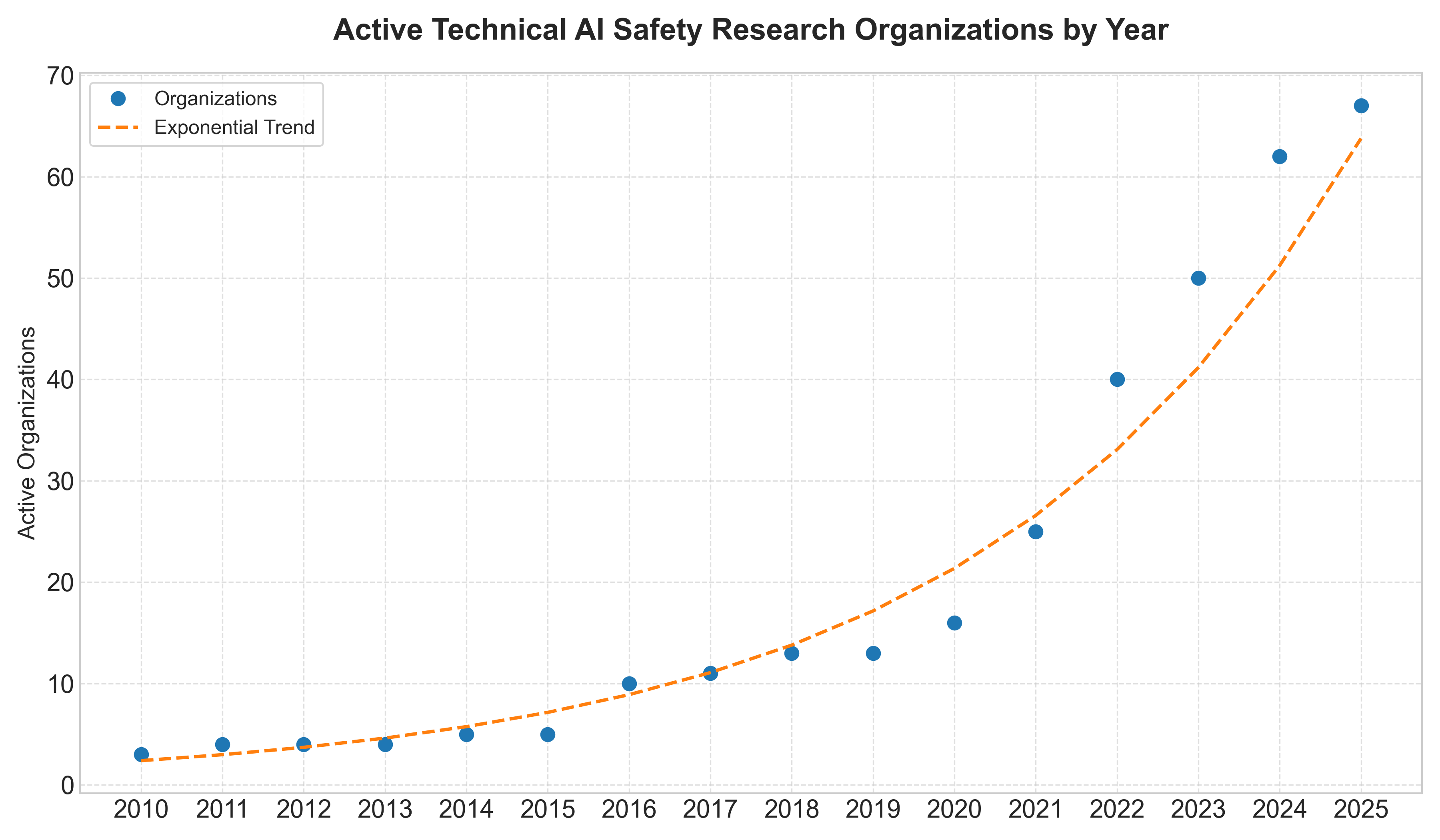
Figure 1: Scatter plot showing estimates for the number of technical AI safety research organizations by year from 2010 to 2025 with an exponential curve to fit the data.
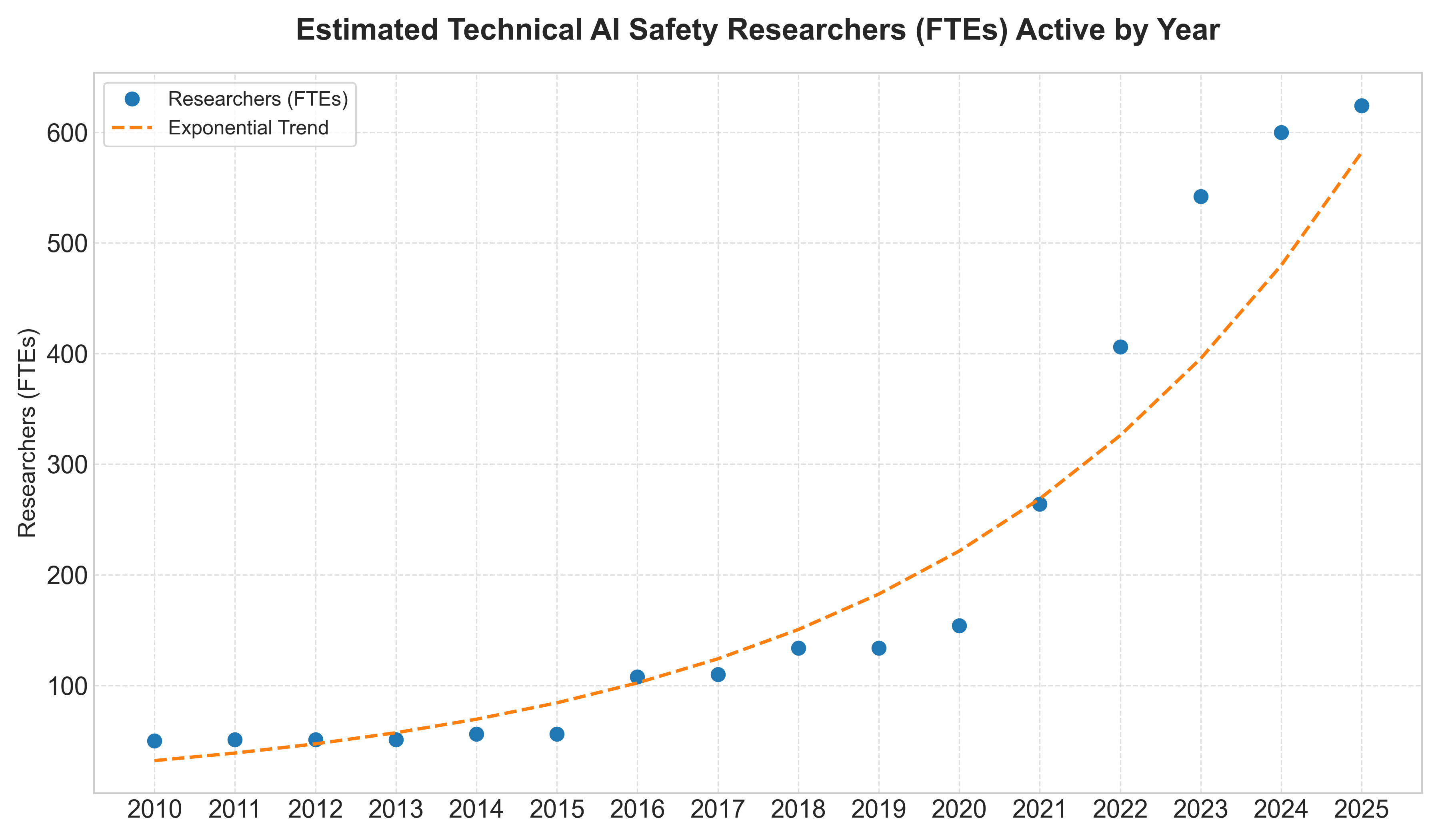
Figure 2: Scatter plot showing the estimated number of technical AI safety FTEs by year from 2010 to 2025 with an exponential curve to fit the data.
The two graphs show relatively slow growth from 2010 to 2020 and then the number of technical AI safety organizations and FTEs starts to rapidly increase around 2020 and continues rapidly growing until today (2025).
The exponential models describe a 24% annual growth rate in the number of technical AI safety organizations and 21% growth rate in the number of technical AI safety FTEs.
I also created graphs showing the number of technical AI safety organizations and FTEs by category. The top three categories by number of organizations and FTEs are Misc t
... (truncated, 54 KB total)d5970e4ef7ed697f | Stable ID: sid_YuvpcI5IGM