Back
Weak-to-strong generalization
webCredibility Rating
4/5
High(4)High quality. Established institution or organization with editorial oversight and accountability.
Rating inherited from publication venue: OpenAI
Data Status
Full text fetchedFetched Dec 28, 2025
Summary
A research approach investigating weak-to-strong generalization, demonstrating how a less capable model can guide a more powerful AI model's behavior and alignment.
Key Points
- •Explores supervision of stronger models by weaker models as an alignment strategy
- •Demonstrated ability to recover significant capabilities through careful supervision methods
- •Highlights the challenges of aligning superhuman AI systems
Review
The paper introduces a novel approach to the superalignment problem by exploring whether smaller, less capable AI models can effectively supervise and control more powerful models. This addresses a critical challenge in AI safety: how humans can maintain control over increasingly sophisticated AI systems that may soon exceed human intelligence. The researchers conducted experiments using GPT-2 to supervise GPT-4, achieving performance levels between GPT-3 and GPT-3.5, which suggests promising potential for scalable alignment techniques. While acknowledging current limitations, the study presents a proof-of-concept that naive human supervision might not suffice for superhuman models, and proposes methods like encouraging model confidence and strategic disagreement to improve generalization. The work opens up a crucial research direction for developing reliable oversight mechanisms as AI systems become more advanced.
Cited by 7 pages
| Page | Type | Quality |
|---|---|---|
| AI Safety Solution Cruxes | Crux | 65.0 |
| AI-Assisted Alignment | Approach | 63.0 |
| AI Alignment | Approach | 91.0 |
| RLHF | Capability | 63.0 |
| Technical AI Safety Research | Crux | 66.0 |
| Weak-to-Strong Generalization | Approach | 91.0 |
| Optimistic Alignment Worldview | Concept | 91.0 |
Cached Content Preview
HTTP 200Fetched Feb 26, 20269 KB
Weak-to-strong generalization \| OpenAI
December 14, 2023
[Safety](https://openai.com/news/safety-alignment/)
# Weak-to-strong generalization
[Read paper(opens in a new window)](https://cdn.openai.com/papers/weak-to-strong-generalization.pdf)

Justin Jay Wang × DALL·E
Listen to article
Share
We present a new research direction for superalignment, together with promising initial results: can we leverage the generalization properties of deep learning to control strong models with weak supervisors?
A core challenge for aligning future superhuman AI systems (superalignment) is that humans will need to supervise AI systems much smarter than them. We study a simple analogy: can small models supervise large models? We show that we can use a GPT‑2‑level model to elicit most of GPT‑4’s capabilities—close to GPT‑3.5‑level performance—generalizing correctly even to hard problems where the small model failed. This opens up a new research direction that allows us to directly tackle a central challenge of aligning future superhuman models while making iterative empirical progress today.
## The superalignment problem
We believe superintelligence—AI vastly smarter than humans—could be developed within the next ten years. However, we still do not know how to reliably steer and control superhuman AI systems. Solving this problem is essential for ensuring that even the most advanced AI systems in the future remain safe and beneficial to humanity.
We formed the [Superalignment team](https://openai.com/superalignment/) earlier this year to solve this problem of superintelligence alignment. Today, we are releasing the team’s first paper, which introduces a new research direction for empirically aligning superhuman models.
Current alignment methods, such as reinforcement learning from human feedback (RLHF), rely on human supervision. However, future AI systems will be capable of extremely complex and creative behaviors that will make it hard for humans to reliably supervise them. For example, superhuman models may be able to write millions of lines of novel—and potentially dangerous—computer code that would be very hard even for expert humans to understand.
Relative to superhuman AI models, humans will be “weak supervisors.” This is a core challenge for AGI alignment: how can weak supervisors trust and control substantially stronger models?
## Our setup
To make progress on this core challenge, we propose an analogy we can empirically study today: **can we use a smaller (less capable) model to supervise a larger (more capable) model?**
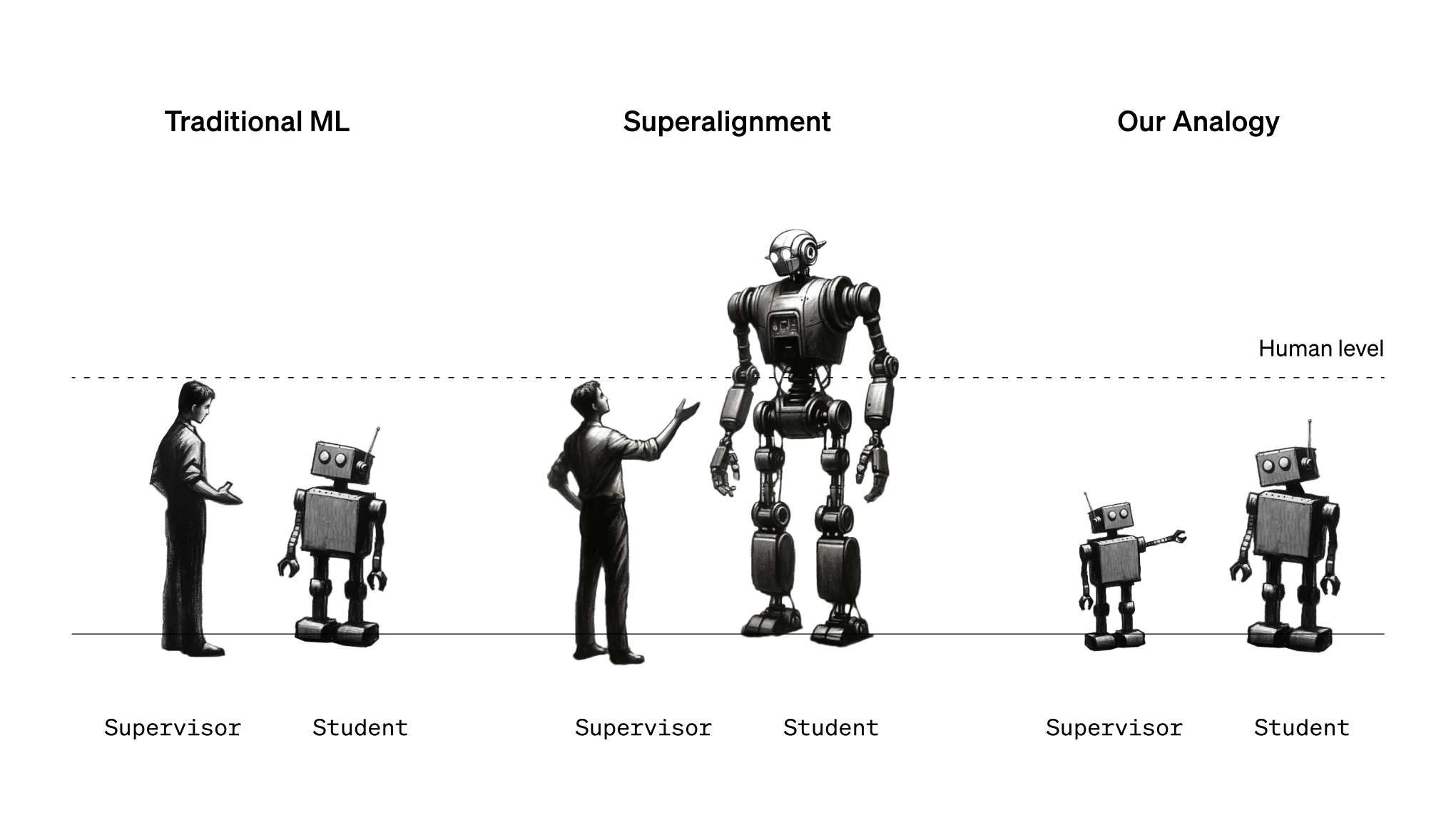
**A simple analogy for s
... (truncated, 9 KB total)Resource ID:
e64c8268e5f58e63 | Stable ID: OWRiY2ZiNG